"Sharp-edge oasis" is the latest in our Wilderness Experienced series of shared stories and musings. We want to hear your story! Learn more and submit a story. |
|
Perched uncharacteristically silent atop a twisted juniper, a Townsend’s solitaire scans the snow-encrusted sagebrush sea for rivals. At the base of the solitaire’s tree, juncos glean seeds from the barren ground.
High above the cinder cones where brilliant cotton candy blue sets an edge against pinkish gray storm clouds, a pair of rough-legged hawks soar an invisible Venn diagram into the cold desert sky. Grown fat on ground squirrels plucked from the nearby hay fields, the hawks near their Arctic departure date.
Flying rapidly through the juniper grove, a flock of mountain bluebirds sings its morning tune. A male’s feathers flash powder blue against snow-capped stone pillars.
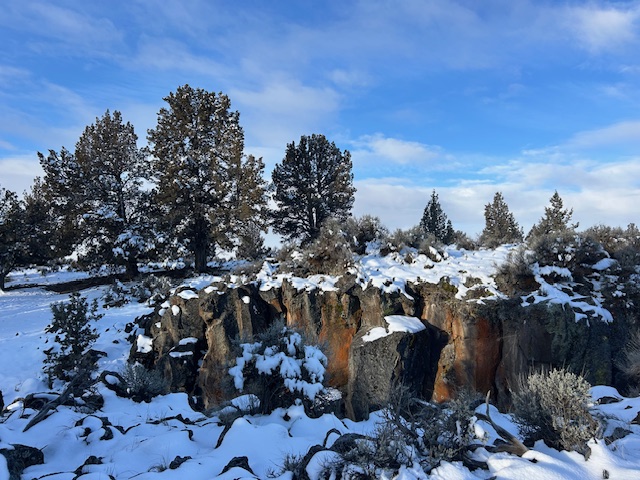
The basalt fissure known as Crack in the Ground marks the western boundary of the Four Craters Lava Beds Wilderness Study Area. The Crack is a road stop attraction for motorists passing through Oregon’s Christmas Valley.
In another month, when the bitterroot blooms and the morning temperature creeps north of 21 degrees, a few eccentrics will stumble upon the Crack, but on this cold Saint Patrick’s Day morning, it’s just me.
The following geologic description is from Norman V. Peterson’s and Edward A. Groh’s Crack-in-the-Ground, Lake County, Oregon, published in The Ore Bin in September 1964:
“The eruptions from the Four Craters were accompanied by a slight sinking of the older rock surface to the southeast. This shallow, graben-like sink is about two miles wide and extends to the south of the old lake basin. Crack-in-the-Ground marks the western edge of this small, volcano-tectonic depression and parallels a zone of weakness concealed beneath the Pleistocene Green Mountain lava flows. The fracture is the result of rupture from simple tension along a hinge line produced by the draping of the Green Mountain flows over the edge of the upthrown side of the concealed fault zone.”
According to rancher and desert storyteller Reuben Long, a person baking in ninety-degree heat at the Crack’s edge could chat with her brother making ice cream from snow tucked into the fissure’s deep recesses thirty feet below. Other than the occasional homesteader ice cream social, or the resourceful Paiute mule deer tracker, the Four Crater’s 12,000 acres of sharp edges have deterred human encroachment.
The Wilderness Study Area’s volcanic rock gardens, denuded cinder cones, hot summers, long, cold winters, and scant rainfall are fixed impediments to cattle grazing, hay growing, and all manner of concrete- and asphalt-centered endeavors. Like much of the Great Basin, the Four Craters is managed by the Bureau of Land Management. Though these shrub steppe lands may be undesirable to Oregonians accustomed to the mild fecundity of the Willamette Valley, the Four Craters is a haven for plants and wildlife struggling to survive civilization’s growth imperative elsewhere.
Here in the Four Craters, some of the oldest junipers, the ones sporting electric green wolf lichens on their branches, and nooks and crannies in their gnarled trunks, are over a thousand years old. The visually striking and acoustically pleasant mountain bluebirds flourishing in this cold desert are cavity nesters. Male mountain bluebirds seek out woodpecker whittled cavities for nest sites. Though its flamboyant feathers and delightful song are exceptional, it is the male mountain bluebird who claims the prime juniper cavity who attracts the mate.
The walk back to the car ends with a slip on the ice and a hard landing. In ten years, such a fall will pad the orthopedic surgeon’s bank account, but today, the misstep provides a chance to breathe in the cold silence.
Sunlit ice slides from a juniper branch and explodes like a glass tumbler on the hard volcanic ground. The whoosh, whoosh of a raven’s wings sends a jackrabbit scurrying for the safety of the sagebrush labyrinth. A coyote’s laugh is channeled through a gap in blinding white cinder cones. Overhead, a turkey vulture lists from side to side.
“If only the old guy broke his hip…maybe next time.” |
|
Help us protect Wilderness around the country. A generous member has pledged to DOUBLE all first-time donations up to $30,000 this year. |
|